A heavy duty paving slab is not a bigger version of a ground mat. It is a pavement layer, and it fails the way pavements fail: in bending over a void, at a joint that cannot transfer load, or by slow creep under a load that never moves. Buyers who compare products on tonnage alone usually end up with a slab that is thick enough and still cracks, because tonnage describes the machine, not the ground it stands on.
The heavy duty paving slabs in this range are UHMWPE or HDPE with single or double-sided anti-skid patterns and several connection options. What follows covers the four decisions that determine whether they survive a project: thickness against wheel load, bedding against subgrade strength, joint detail and polymer grade. It is written for the engineer drafting the purchase specification, not for the catalogue.
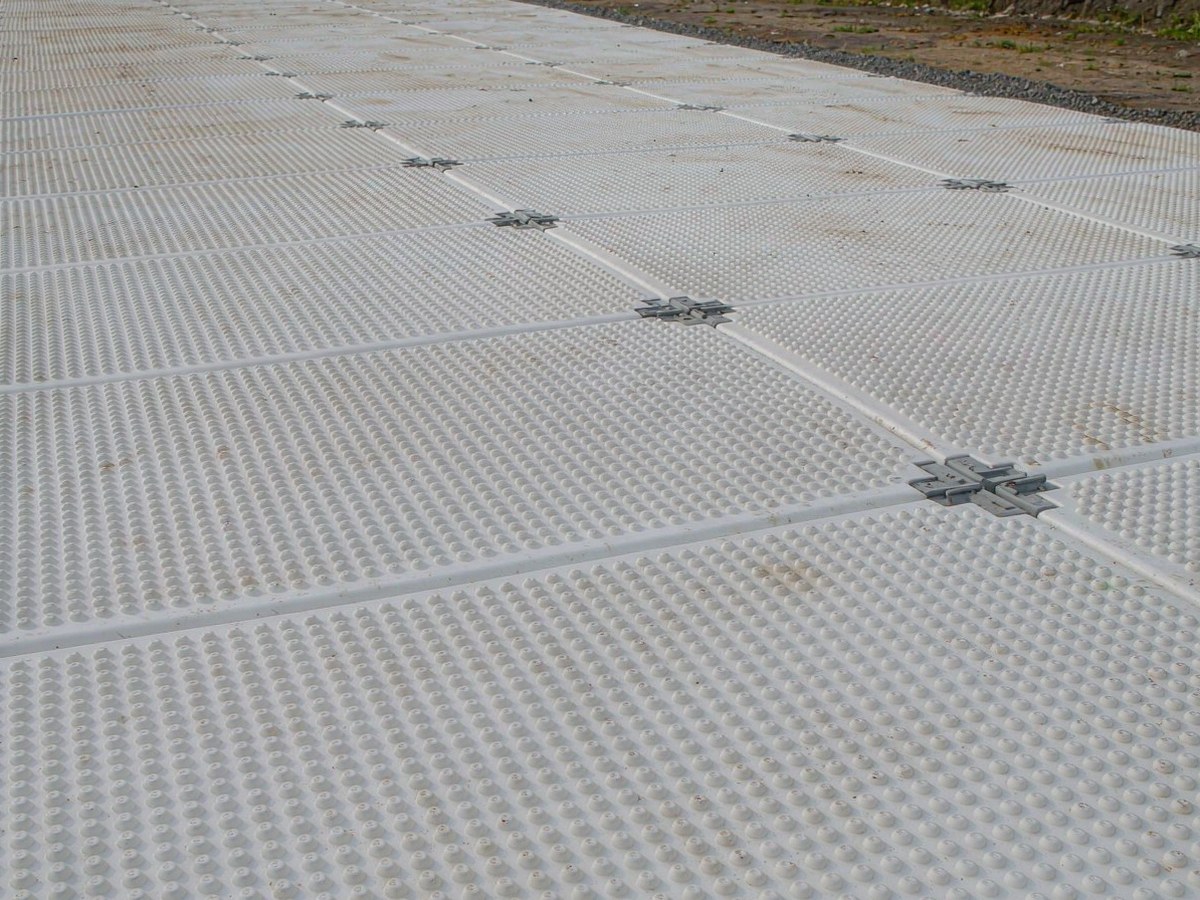
A slab laid on soil is a plate on an elastic foundation. Its resistance to bending scales with the cube of its thickness, so the step from 15 mm to 20 mm is not a 33 percent improvement, it is roughly a 2.4 times increase in bending stiffness. That is why the thickness bands in a supplier catalogue are narrow and the price steps are steep, and why a 15 mm slab that performs well on a footpath can fail within a week under a loaded tipper truck.
Two consequences follow. Stiffness only helps if the load spreads before it reaches the soil, so a slab that is too small in plan, or laid on uncompacted fill, punches down as a rigid block and extra thickness changes nothing. And the modulus on a datasheet is a five-minute value; polyethylene creeps, so the modulus governing a slab under a load held for weeks is a fraction of it.
An excavator weighing 30 tonnes does not put 30 tonnes on one slab. It puts a share on each track shoe, and the number that matters is load per wheel or per track divided by contact area. A loaded tipper axle carrying about 10 tonnes per side delivers a wheel load in the order of 50 kN over a contact patch of roughly 0.03 to 0.04 square metres at normal inflation pressure. A walkway and a haul road can therefore serve the same machine class with completely different slabs.
Three bands cover most heavy duty paving slabs on site. Slabs of 12 to 15 mm suit pedestrian routes, wheelbarrows and light vehicles up to about 3.5 tonnes on firm, level ground. Slabs of 20 to 25 mm carry rigid trucks, mixers and telehandlers on prepared bedding, and are the normal choice for site haul roads and compound paving. Slabs of 30 mm and above are for repeated heavy axle traffic, container legs and piling rigs, where load is high and often concentrated.
Outrigger positions deserve separate treatment because the load is static and very high. Where a crane stands for weeks, the sound solution is a crane outrigger pad sized on the actual reaction force, sitting on a steel plate or compacted granular fill, so the polymer spreads the load and the steel provides stiffness.
Every supplier states a load rating. Almost none states the subgrade that rating assumes, and that omission is where failures start. A slab rated for 40 tonnes on compacted granular fill is not rated for 40 tonnes on saturated clay. If the tender does not fix the bedding and the bearing capacity, the rating is decoration.
Two rules cover most cases. The bedding must be continuous: a slab bridging a rut, a protruding stone or the edge of a trench is a slab in bending, and bending is what cracks polyethylene. And the slab must be wide enough in plan for the load to spread at roughly 45 degrees through the bedding; narrow strips on soft ground fail at the edge whatever the thickness.
On genuinely weak subgrade the answer is usually geotextile, then granular layer, then slab, in that order. The geotextile stops fines pumping, the aggregate spreads the load, and the slab provides the running surface and abrasion resistance. A slab laid straight onto wet silt will sink however thick it is, and the site will blame the material.
Individual slabs are stiff. A field of heavy duty paving slabs connected only by gravity is a collection of loose plates, and every joint becomes a hinge and a pump. Once traffic rocks the slabs at a joint, fines migrate, the gap opens, edges spall, and the pavement unravels outward from that line. This is the most common reason a well specified installation underperforms its material.
The joint must transfer shear, and there are three workable details: an interlocking tab and slot moulded into the edge, a loose steel dowel through aligned holes, or a mechanical connector bolted across the joint. Moulded tabs are fastest to lay and fine for light traffic. Dowels suit heavy axle loads because they carry shear without relying on moulding accuracy. Bolted connectors are strongest but slow, and every hole is a stress raiser, so keep them at perimeters and ramps.
Two layout rules save most installations. Stagger joints between rows as in brickwork, so no continuous joint line runs across the running surface. Keep joints out of the wheel path, because the joint where every truck wheel lands opens first. Where slabs butt against a kerb, wall or steel edge, leave a gap with a compressible strip rather than packing them tight.
Polyethylene is slippery when wet, and a smooth slab on a slope in the rain is a safety incident waiting to be reported. A raised pattern, whether diamond array, longitudinal ribs or studded field, restores grip by giving water somewhere to go and presenting edges to the tyre. Pattern depth matters more than pattern design; a shallow texture that wears flat in a season is worse than none, because it advertises grip it no longer provides.
The pattern has a second job on unpaved sites. Mud, coal dust, grain and mineral concentrate pack into a smooth surface and turn it into a skating rink within days. A patterned slab sheds most of that under traffic and what remains can be washed or scraped out. Run ribs across the direction of travel, not along it, or they channel water instead of shedding it. On steep ramps, a dedicated ramp section with an aggressive pattern is cheaper than the claim that follows a fall.
Labels such as PE500 or PE1000 are supplier designations, not standards, and two slabs with the same label can differ by a factor of two in abrasion resistance. What can be tested is molecular weight, usually reported through intrinsic viscosity, and density. For paving work a weight-average molecular weight in the 3 to 9 million range is normal; below that, creep under sustained load becomes the limiting factor rather than strength.
Density for virgin UHMWPE sits around 0.93 to 0.94 grams per cubic centimetre. Anything materially above that indicates fillers, which may be legitimate for UV stabilisation or flame retardancy, but must be declared. Recyclate is common in this category and not automatically bad, though it raises ash content and lowers elongation; if the slab must resist impact in cold weather, ask for virgin content and an impact test result rather than accepting a colour-based assurance.
Two more lines belong in the specification. Carbon black at roughly 2 percent is the standard UV stabiliser, and it matters for slabs stored outdoors between projects. And the service temperature window should be stated: standard grades work from about minus 30 to plus 60 degrees Celsius, with impact strength falling sharply at the cold end, which matters for winter site work.
The linear expansion coefficient of UHMWPE is roughly 1.5 to 2.0 times ten to the minus four per Kelvin, about ten times that of steel. A six metre slab moves nine to twelve millimetres over a ten Kelvin swing, and a dark surface in direct sun swings far more. Installations that butt slabs tight against a fixed structure buckle in summer and tear at fasteners in winter. Leave expansion gaps at every fixed edge and let the joint detail absorb movement instead of restraining it.
Creep is the slower problem. A container leg, a stored mast section or a static outrigger load held for months presses a permanent dimple into any thermoplastic slab, and the dimple becomes a low point that collects water and accelerates the next failure. For loads held longer than a few weeks, either increase the pad area so contact stress drops, or put a steel plate between load and slab.
Where the slab is also the wear surface, plan the wear allowance deliberately. A paving slab in a transfer area carrying abrasive bulk material loses thickness predictably, and a slab chosen only for structural thickness is scrap in one season. In those positions a wear resistant UHMWPE sheet grade with published abrasion data is the better starting point, while a ground protection mat is the right answer only where the need is temporary access rather than a running surface.
Bending fracture across a void. The slab spans a rut or soft pocket, a wheel lands mid-span, and a crack runs across the surface. Cause: bedding, not material. Fix: re-level and blind the formation before relaying.
Edge spalling at joints. Corners break away because the slab rocks and the edge takes point load. Cause: no shear transfer. Fix: dowels or interlocking tabs, and re-lay opened joints rather than patching them.
Permanent indentation under static load. A dimple appears under an outrigger or container corner. Cause: creep at high contact stress. Fix: larger pad area or a steel spreader plate.
Joint gap growth and fines pumping. The pavement opens along a line and bedding washes out beneath. Cause: unrestrained movement plus water. Fix: staggered joints, correct gap, geotextile separator under the bedding.
Surface pattern worn flat. The slab is structurally sound but has lost grip, usually in the wheel tracks. Cause: texture depth too shallow for the traffic. Fix: specify depth against traffic class, and rotate slabs between projects so worn areas do not return to the same position.
Buckling or fastener tear-out at a fixed edge. Slabs lift or bolt holes elongate after a hot spell. Cause: restrained thermal movement. Fix: slotted or oversize holes, expansion gaps, and never clamp a long run between two rigid structures.
Write the enquiry so every supplier quotes the same thing and delivery can be checked against it. One: dimensions and thickness with tolerance, and whether thickness is nominal or minimum. Two: polymer type, molecular weight or intrinsic viscosity, and the test method. Three: density and declared filler content, with virgin versus recyclate as a percentage. Four: UV stabilisation and service temperature range. Five: surface pattern type and depth. Six: joint detail, including whether dowels and connectors are supplied and in what quantity. Seven: colour, and whether it is through-colour. Eight: flatness and edge squareness, since a bowed slab will not close its joints. Nine: the load rating with the subgrade and bedding it assumes, in writing.
Add two site questions that never appear in catalogues: what is the actual wheel load and contact pressure, and how long will the pavement stay in place? Those answers decide the thickness band, and they separate a slab that lasts the project from ones replaced twice. Send us the axle load, the subgrade description and the duration, and we will confirm thickness, joint detail and pattern for your layout.