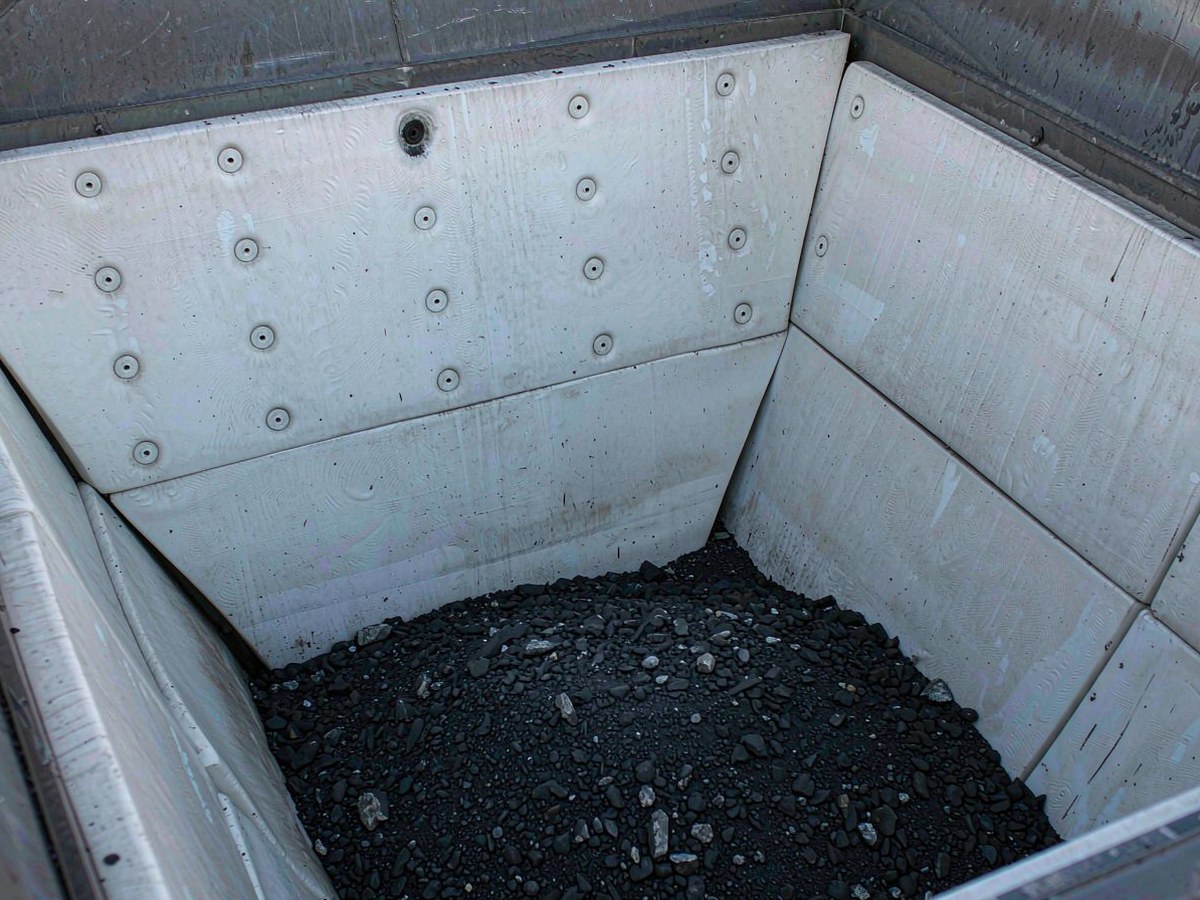
Every sheet supplier on the market sells a wear resistant UHMWPE sheet, and almost none of them will say which wear mechanism the claim refers to. That matters, because sliding abrasion, direct impact and slurry erosion attack a polymer in three different ways and rank materials in three different orders. A grade that wins a dry sliding test can lose badly at a ninety degree impact point, and a liner chosen for impact toughness will polish away in a fine slurry line. Before prices are compared, the duty has to be described in physical terms.
The practical consequence is that wear is a property of the system, not of the sheet. Particle size, particle shape (angular crushed rock against rounded sand), moisture, velocity, impact angle, temperature and the condition of the steel behind the liner all change the answer. Two plants running the same nominal material at different chute angles get different service lives. The job of a specification is therefore not to name a magic grade, but to pin the conditions down well enough that a supplier can be held to a number.
Sliding abrasion is the gouging mode. Bulk solids slide across the surface and hard particles cut fine grooves. Resistance depends on the polymer recovering elastically after each pass, which is why ultra high molecular weight grades outrun HDPE by a wide margin despite nearly identical chemistry. Thickness matters less here than surface quality, because a deeply scratched surface accelerates its own wear by holding grit against the plate.
Impact wear is the opposite problem. At transfer points and crusher discharge, rock lands at speed and the surface has to absorb energy. A hard thin sheet is a liability in that position: it cracks, spalls, or dishes around the fasteners. What the duty needs is thickness, continuous backing support, unbroken virgin resin and a fixing pattern that spreads load instead of concentrating it under a bolt head.
Slurry erosion is the quiet one. Fine solids carried in water at three to five metres per second remove material uniformly and slowly, and the failure reads as a polished thin patch rather than a hole. It is the mode most often misdiagnosed as soft plastic, when in fact the conveying velocity and the solids load were simply beyond what any thermoplastic lining survives at that thickness. On those duties the honest answer is often a thicker panel or a different material, not a premium grade of the same sheet.
There is no single international abrasion rating for polyethylene. A supplier quoting a wear index of 15, or five times the life of steel, is quoting an internal comparison, and the number only means something if the method travels with it. Ask which standard, which abrasive, which load, which distance, and whether the result is mass loss or volume loss.
The two methods actually quoted for PE-UHMW are ASTM G65, the dry sand rubber wheel test reported as volume loss in cubic millimetres, and ASTM D4060, the Taber test reported as milligrams lost per thousand cycles. They are not interchangeable and neither reproduces a wet chute. A G65 figure describes behaviour under a controlled sand stream; a Taber figure describes behaviour under a rotating wheel with loose grit. Comparisons built across the two numbers are meaningless.
Two traps are worth naming out loud. ISO 4649 is a rubber test on a rotating drum with abrasive sheet, and it is routinely cited for plastics by people who never read the scope. ISO 15527 is the specification for compression moulded PE-UHMW and PE-HD sheet: it fixes dimensional tolerances, density and property minima, and it is not an abrasion test. Both are legitimate documents. Neither is a wear warranty.
Convert before you compare. Volume loss divided by density gives mass, and unfilled PE-UHMW sits around 0.93 to 0.94 grams per cubic centimetre. A supplier reporting 90 milligrams and another reporting 100 cubic millimetres are not ten percent apart or ten times apart until somebody does the arithmetic.
Abrasion resistance rises with molecular weight across roughly three to nine million grams per mole, then flattens. Past about five million, the gain per extra million is small while the processing penalty is not: ram extrusion and compression moulding slow down, residual stress and dimensional movement get worse, and price climbs. A nine million grade sold at a thirty percent premium for a low impact hopper liner is money spent on a property the duty never uses.
The labels PE300, PE500 and PE1000 are supplier families rather than standards, and they do not translate between brands. Where molecular weight is commercially important, specify the test instead: intrinsic viscosity in decalin to ISO 1628-3, or at minimum a density and ash content pair that proves the sheet is unfilled. A mill certificate with a real viscosity range and a batch number beats any trade name, and the sheet options and stock thicknesses on the wear resistant sheet specification page are written in those terms.
Watch the ash figure. Filled and reprocessed sheets are sold as wear grades and can be perfectly serviceable in low impact sliding duty, but fillers dilute the polymer that does the wearing. Ash above roughly one to two percent is a prompt to ask what was added and why. For food, pharmaceutical or potable water contact, reprocessed resin is out regardless of how well it wears.
Stop specifying thickness by habit on a wear resistant UHMWPE sheet. Thickness is the material you are allowed to lose before the part fails, and it can be estimated. Measure the first liner properly: original thickness, install date, and the thickness at the worst patch every three months with a caliper or an ultrasonic gauge. Two readings give a rate in millimetres per thousand operating hours, and that rate multiplied by the target interval between shutdowns is the thickness you should have bought.
Two constraints sit under that number. Residual thickness at end of life should not fall below about forty percent of the starting figure at a bolted area, because the countersunk head and washer stack need material around them; below that the liner fails by pull through rather than by wear. And the practical sheet range is coarse, at six, eight, ten, twelve, fifteen, twenty and twenty five millimetres, so round up rather than designing a thirteen millimetre part that nobody stocks.
A worked example. A twelve millimetre chute liner losing 0.4 millimetres per thousand hours reaches seven millimetres residual, fifty eight percent, after about twelve thousand hours. At six thousand operating hours a year that is a two year interval with a comfortable margin, and twelve millimetres is the right call. The same arithmetic on a twenty millimetre panel would have doubled the spend for no operational gain.
Natural milky white sheet is the default for virgin unfilled PE-UHMW. Green is a plant convention, not a performance grade. Black almost always means carbon black at roughly one to two percent, added for UV stability in outdoor stockpile and truck bed duty; it does not make the sheet more abrasion resistant, and assuming it does is a common and expensive mistake.
Some duties need a different compound rather than a different colour: antistatic or conductive grades for dust and solvent environments, flame retardant grades for enclosed conveyors and tunnels, and food contact grades with a declared compliance statement. Each of these trades away some impact strength or adds cost, and each deserves its own line on the purchase order. Do not accept same sheet, different colour as an answer to a fire or static requirement.
Most liner failures are not wear failures. They are fixing failures. Countersunk heads must sit below the wear surface with enough surrounding material, and holes should be drilled rather than punched, because a punched hole leaves a stress raiser that starts a crack within a season. Head depth plus two millimetres of cover is a reasonable minimum, and the same detail applies to the wear strips and guide rails summarised on the UHMWPE sheet overview.
Thermal expansion is the other silent killer. PE-UHMW moves roughly 1.5 to 2.0 x 10^-4 per kelvin, an order of magnitude more than steel. A three metre panel sees close to nine millimetres of movement across a fifty kelvin swing. Fix one end, slot the rest, and never clamp both ends of a long run, otherwise the sheet buckles off the plate and the material stream gets underneath it.
Joints matter as much as bolts. Butt panels tight and overlap in the direction of flow, or leave a two to three millimetre gap closed by a cover strip; an open step facing the flow will be undercut within weeks. Seal the top edge and every penetration, because once fines get behind the sheet they act as a grinding paste and the steel plate corrodes while the liner still looks new. The same logic governs chute liner retrofits, where the existing shell is rarely flat.
Unfilled PE-UHMW works to about eighty or ninety degrees Celsius in continuous service. Above that, oxidation and creep start to compete with wear as the governing failure mode. It stays tough at low temperature well below freezing, but impact loaded parts deserve review below roughly minus forty, where notched impact values fall and brittle edge failure takes over. Friction on dry steel is commonly quoted at 0.10 to 0.15 static and 0.05 to 0.10 dynamic, and that number, not hardness, is what justifies the material in sticky hoppers that bridge.
Chemical limits are hard lines rather than preferences. Aromatic and chlorinated solvents, strong oxidisers and some concentrated acids will swell or degrade the sheet, and no thickness increase fixes that. Check the specific medium and its concentration before the grade conversation starts, not after a quotation has been issued.
Pull through at fasteners, usually from under thickness at the countersink or from bolts torqued until the head sinks. Edge lifting and undercutting, from a step facing the flow or a missing cover strip. Thermal buckling, from both ends clamped. Embedded fines behind the sheet, from an unsealed top edge or drilled holes without sealant. And oxidation chalking outdoors, where the surface dulls, the wear rate climbs, and a carbon black grade would have prevented it while a thicker sheet would not.
Keep a photograph and a thickness reading for each event. After two or three years you own a wear rate by position, which is worth more than any datasheet and turns the next purchase into a calculation instead of an argument with a supplier.
A useful request for quotation on a wear resistant UHMWPE sheet fits in ten lines: material and grade with the molecular weight evidence you will accept; sheet thickness and tolerance; colour and additive package; panel sizes with a cutting list; hole pattern, countersink detail and whether holes are drilled at the works; operating temperature range; conveyed material with particle size and moisture; target service interval; and the documents you want with the shipment, meaning mill certificate, batch traceability and any food or fire compliance statement.
Send those ten lines with a sketch and the wear history of the liner being replaced, and most of the ambiguity disappears from the quotation. A supplier who cannot answer a thickness or tolerance question in writing is telling you something useful about how the part will arrive on site.