A borated UHMWPE sheet is bought for one reason: hydrogen in the polyethylene chain slows fast neutrons down, and boron captures them once slow. Everything else in the specification, thickness, density, lead content, molecular weight, supports those two steps. When a shielding job underperforms it is rarely the polymer. It is one of those steps starved, or a sheet specified by habit instead of calculation.
This guide is for the engineer who signs the order: what boron content buys, where thickness stops helping, and which details in a quotation reveal whether the supplier understands the application. No dose rates are promised, because a sheet supplier cannot certify one without your geometry and spectrum.
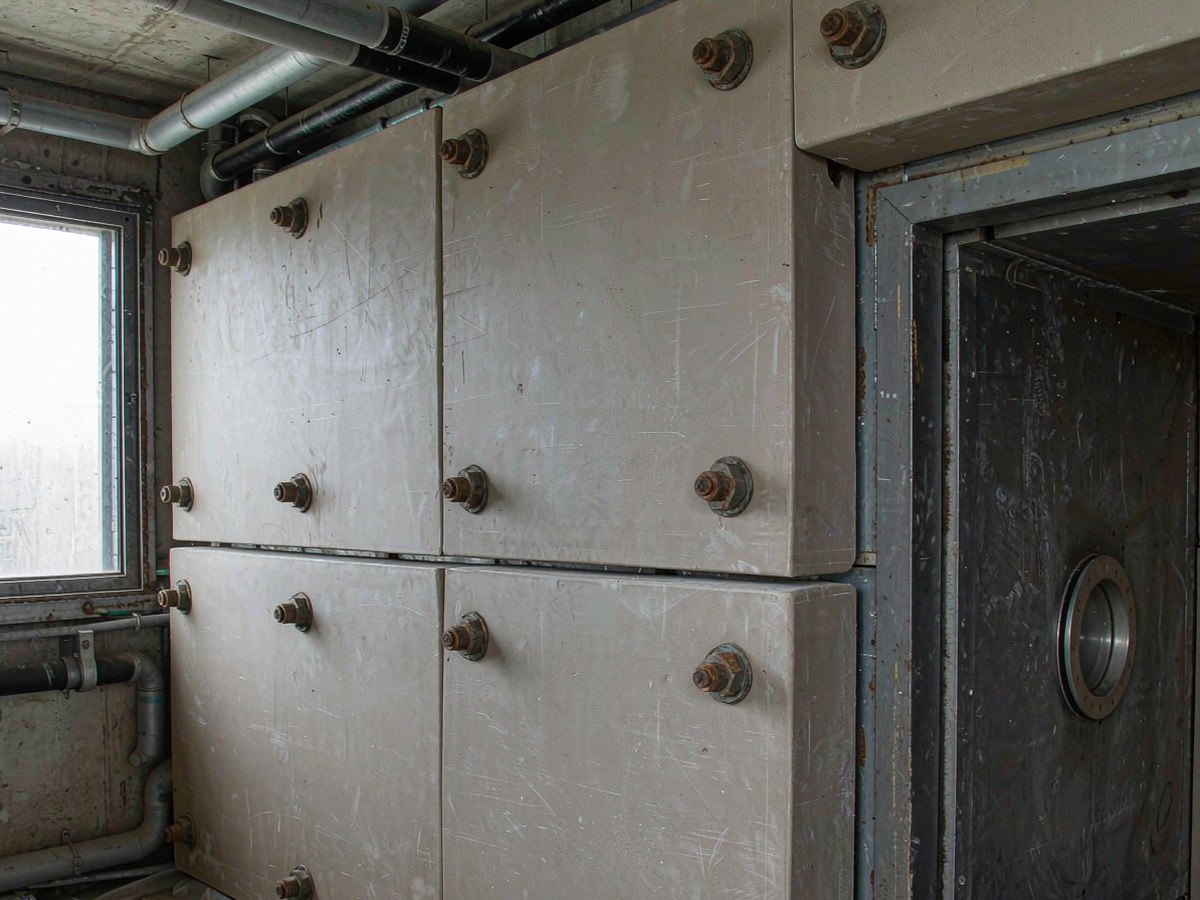
Polyethylene is roughly 14 percent hydrogen by mass, the highest of any common solid polymer. A fast neutron born at a couple of MeV loses energy through elastic collisions with those nuclei, and since a proton and a neutron have nearly equal mass, each collision strips a large fraction of the neutron’s energy. A dozen or so collisions bring it to thermal energies. That is moderation, and polyethylene is very good at it.
The problem is what follows. Hydrogen has a thermal capture cross section of only about 0.33 barns, so the neutron wanders through the board for a long time before capture, and that capture releases a 2.22 MeV gamma ray. A plain polyethylene panel slows neutrons well, captures them badly, and converts the survivors into a gamma source. A wall that reads clean on a neutron meter and hot on a gamma meter is usually showing exactly this.
Boron closes the gap. Boron-10 has a thermal capture cross section near 3840 barns, four orders of magnitude higher than hydrogen. The reaction emits an alpha particle and a lithium recoil plus a 0.48 MeV gamma, and both charged particles stop within microns, inside the sheet, so the neutron is removed rather than converted. Natural boron already carries about 19.8 percent boron-10, so industrial shielding needs no enrichment.
The common ambiguity here is the basis of the boron figure. A quotation saying 10 percent boron may mean elemental boron or boron carbide by weight. Boron carbide is about 78 percent boron by mass, so a board loaded with 10 percent B4C carries only about 7.8 percent elemental boron. On a job sized close to the limit, that 22 percent shortfall is the difference between passing and failing a commissioning survey. Insist the certificate states the basis, and convert before comparing suppliers.
More boron is not a linear improvement. At industrial thicknesses the limiting step is usually moderation, not capture: a neutron must be slow before boron can act, so adding absorber to a board too thin to thermalize the spectrum changes little. In practice 5 percent elemental boron covers most laboratory and medical walls, 10 percent is the working grade for accelerator bunkers and hot cells, and 15 to 20 percent is reserved for thin close-in panels and spent fuel work where space binds. High loading also costs mechanically, because boron carbide near 2.5 g/cm3 displaces polyethylene, so impact strength and elongation fall with every percent.
Attenuation through a hydrogenous slab is exponential, with a relaxation length that depends strongly on the incoming spectrum. A 2 MeV fission neutron, a 15 MeV accelerator neutron and a thermal field do not need the same slab. Thickness advice quoted as a single number, such as 100 mm is enough for a medical room, is a starting point for the radiation protection consultant, not a purchase specification for a borated UHMWPE sheet.
Published work points the same way. A 2026 Geant4 study of a deuterium-deuterium source, reported in Nuclear Analysis, compared polyethylene, borated polyethylene, lead, tungsten and concrete. Borated polyethylene was most effective at slowing and absorbing fast neutrons, while dense metals won against secondary gamma. The recommended build was layered: borated polyethylene on the source side, high-Z outside. That ordering is the engineering argument for a lead-boron composite.
Thickness and loading cannot be traded freely. A 2026 study of cosmic-ray neutron backgrounds for a reactor antineutrino detector at Taishan, in the Journal of Instrumentation, measured transmission through water, HDPE and 40 percent boron-loaded HDPE, reporting that a 30 cm slab cut fast and thermal flux by more than 95 percent. That is a thick, heavily loaded slab. A 10 mm sheet would not reproduce it, and neither would 300 mm at 2 percent boron. Both variables work, in series.
Lead loading turns a neutron shield into a mixed-field shield. Gamma attenuation depends on areal density, so lifting density from 0.93 g/cm3 toward 3.4 g/cm3 buys real reduction in transmission per millimetre. On spent fuel casks, hot cell windows and radiography enclosures, handling both components in one panel removes an installation step.
It is a compromise, not a substitute for metallic lead. Per unit of attenuation, dispersed lead is less efficient than solid lead, and the matrix limits temperature and creep resistance. There is also a secondary gamma penalty: fast neutrons scatter inelastically in heavy nuclei and produce capture gammas in the high-Z layer, which is why boron side in and lead side out is preferred. For a gamma-only field this board is the wrong purchase, because boron earns its place only when neutrons are present.
Material is normally specified between 3.5 and 9.0 million g/mol, and molecular weight governs abrasion, impact, creep and stress cracking. It does not govern attenuation, which depends on hydrogen density, boron-10 areal density and mass per unit area. A supplier arguing that a higher grade shields better is selling an upgrade that will never show on a survey meter. It still matters for handling: panels are knocked and bolted through, and 5 million g/mol resists bolt-hole elongation better than a low molecular weight grade loaded with 30 percent ceramic. For static wall infill, 3.5 to 5 million is adequate; for doors and movable barriers, specify higher.
Boron carbide at 2.5 g/cm3 does not want to stay suspended in a polyethylene melt at 0.93 g/cm3. In a poorly controlled pressing cycle it settles, producing a board boron-rich at the bottom face and lean at the top. The panel then passes a coupon test taken from the rich side and underperforms in service on the lean side, and no certificate catches that unless the certificate is tied to position.
Density is the practical proxy. A 10 percent boron carbide grade should sit at or above about 1.03 g/cm3, and a well-made board holds variation across the sheet within roughly 0.01 g/cm3. Check it before installation: cut coupons from the centre and two corners, measure dimensions and weigh. A spread wider than one percent means the pressing cycle was not uniform. Thickness tolerance and flatness deserve equal attention, since bow on a large panel prevents flush mounting against a wall or behind a steel liner.
Natural or white sheet is the default for cleanrooms, radiopharmacies and anywhere contamination is surveyed by wipe test, because contamination shows on a light surface and wipes off a smooth one. Black sheet hides handling marks, resists UV outdoors and picks up slight surface conductivity. Blue usually marks a flame-retardant grade, useful on site because the two otherwise look identical.
Every additive that is not hydrogen dilutes the moderator. Carbon black, flame retardants, antistatic agents and the boron compound all displace polyethylene volume, so a flame-retardant board can carry 10 to 15 percent less hydrogen per unit volume than the neat grade. Ask whether the calculation used the modified density or the base resin. The boron compound matters more: boron carbide is insoluble and inert, while borax and boric oxide dissolve, so a borax-based board loses absorber into standing water, which in a wet nuclear environment is both a performance failure and a contaminated effluent problem.
A shield is only as good as its seams. Every through-bolt is a straight hole through the moderator, and a line of bolts at 300 mm centres can leak more flux than the panel attenuates. Counterbore the fixings and plug the heads with the same material, stagger seams between layers, and lap or step joints rather than butting them. For gamma, overlap lead-bearing panels by at least a tenth-value thickness.
The material machines like soft hardwood. Standard woodworking tooling works, but boron carbide is abrasive, so use carbide tooling and good dust extraction, because that dust is a ceramic powder nobody should breathe. Tapped holes hold poorly in a filled grade, so through-bolts with backing washers beat threads cut into the sheet. Having the supplier profile the panels is usually cheaper than machining on site, and profiling to the same drawing as the mounting steel keeps clearances consistent, as with our machined UHMWPE sheet components.
The service window is roughly minus 169 to plus 80 degrees Celsius, and within it dimensional behaviour is dominated by thermal expansion, since water absorption is below 0.01 percent. Expect one to two millimetres of growth per metre over a 50 K swing, which on a three metre panel is four to six millimetres, enough to bow a panel bolted tight at both ends. Leave perimeter clearance, use slotted holes on one axis, and do not ask the bolts to restrain expansion. Joints also relax as the polymer creeps, so large washers and a modest preload with a re-torque beat a high initial torque.
You do not need a neutron source to protect yourself on delivery. Weigh a full sheet and compute density from measured dimensions, measure thickness at five points, and cut an edge coupon to look for filler streaks through the thickness. Send a coupon for boron assay by titration, and for lead by X-ray fluorescence where lead is specified. Ask for the batch record, and confirm the certificate ties the boron figure to elemental boron or to boron carbide. Two questions matter before the order: whether all sheets come from one press batch, because mixing batches on one wall is the quiet route to non-uniform shielding, and whether the grade is repeatable in eighteen months, because extending a wall with a differently loaded panel recreates the gradient the design avoided.
Filler settling yields a panel dense at one face and lean at the other, a fault invisible in a dimensional check. Unbaffled seams stream in a straight line that no extra thickness corrects. Soluble boron compounds leach in wet rooms, so the shield degrades where it is hardest to replace. Over-constrained edges bow panels off their backing and open the gaps the design meant to close. And the most expensive failure is a borated panel specified for a pure gamma field, where the money went into an absorber with nothing to absorb.
A useful enquiry states the spectrum or at least the source type, the dose target and the distance at which it applies, the cavity dimensions, whether gamma is present and at what energy, the environment, the fixing method and the certification required. On the material side: boron content with its basis, the boron compound, lead content, density and permitted variation, thickness with tolerance, sheet size, molecular weight, colour and any flame-retardant or antistatic requirement. Where static also matters, carbon black and boron compete for the same volume, as covered in our antistatic UHMWPE sheet guide.
Where one panel must handle neutrons and gamma together, the lead-boron UHMWPE sheet range covers 10 to 200 mm thickness with boron from 2 to 20 percent and lead from 5 to 30 percent by weight, in sheets up to 3000 x 2000 mm, machined to drawing. Send the geometry, the spectrum and the target, and a borated UHMWPE sheet specification can be matched to your calculation rather than to a catalogue figure.