Most sheave failures on site get blamed on the rope. The rope is usually just the messenger. Once a groove loses its profile, the rope stops bedding on a full arc of contact and starts sitting on two shoulders, and the wire breaks appear three or four metres away from the wheel that caused them.
UHMWPE Pulley, Roller & Sheave parts are machined from virgin stock rather than moulded, which is the only reason they can hold a groove profile and a bore tolerance at all. What follows is how to read the drawing, where each number comes from, and which duty a polymer wheel will actually survive.
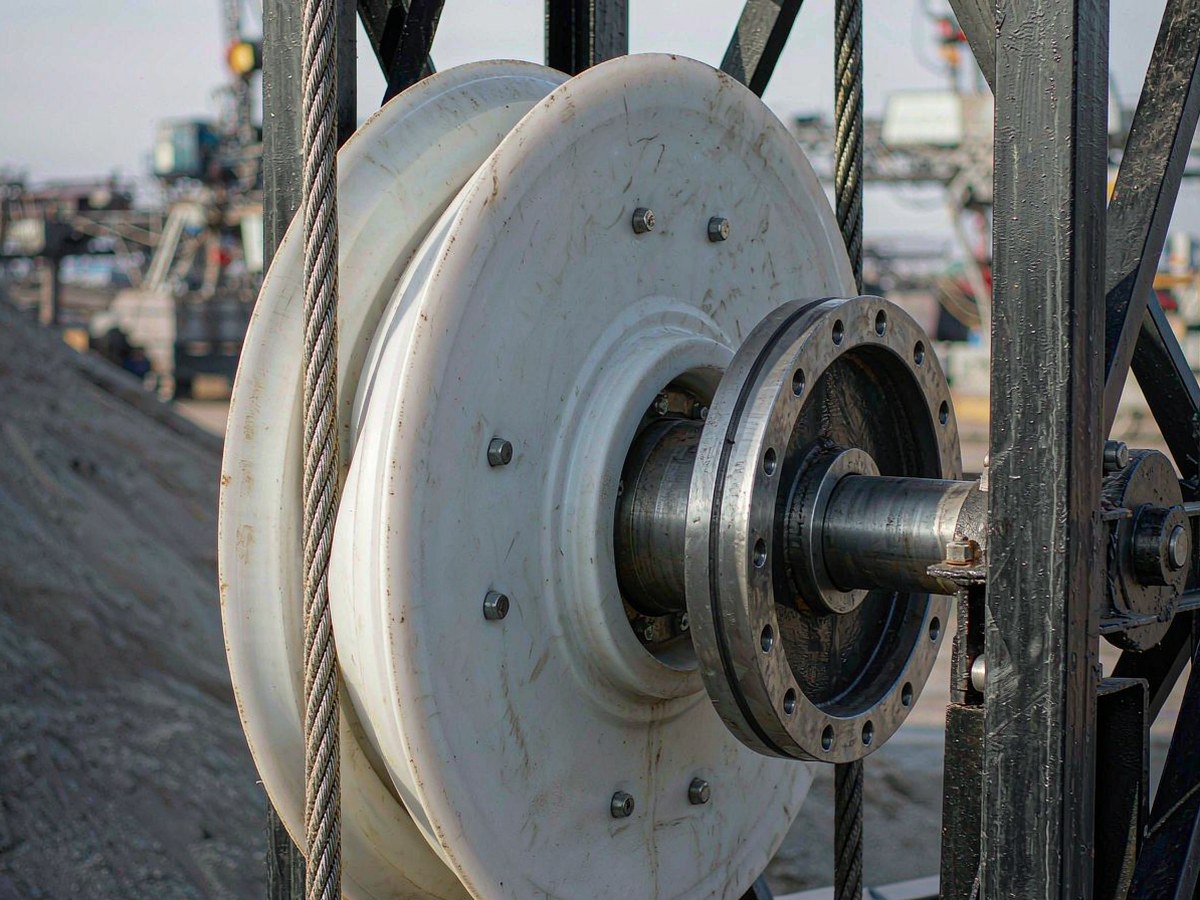
It is not a load upgrade. A polymer wheel adds no capacity to a crane or a conveyor drive, and it does not let you run a larger rope. If the steel sheave was sized at a pitch diameter of sixteen times the rope diameter, the polymer replacement is sized the same way. Anything else is a redesign, and that needs the rope supplier in the room.
Where the material wins is the environment around the rope rather than the load in it: wet coal and slurry, salt and fertiliser dust, acid plant, washdown lines, quay fairleads where a steel wheel is a rust farm. Corrosion pits a steel groove into a file, and a file cuts wire. UHMWPE does not pit and holds a low friction face against both rope and belt.
Where it loses is heat, speed and shock. Sustained pull at a small diameter-to-rope ratio, belt drives that build heat at the rim, and any duty where a groove failure is a safety event with no secondary catch belong to steel or to a cast nylon with a far higher modulus. Our UHMWPE pulley and sheave range is quoted for up to 25 kN dynamic load per sheave, and that is not a licence to ignore the duty cycle.
Outer diameter, groove diameter and pitch diameter are three different numbers, and purchase orders confuse them more than any other item on the sheet. Outer diameter runs 100 to 1200 mm, groove diameter 80 to 1100 mm, rim thickness 25 to 150 mm, bore 20 to 250 mm. None of those governs rope fatigue.
Pitch diameter is groove bottom diameter plus one rope diameter, and that is the value the rope standards work from. ISO 4309 practice puts groove diameter five to ten percent above nominal rope diameter, and at least one percent above the measured diameter of the new rope. A groove cut tight pinches and shears strands; a groove cut loose lets the rope flatten and lose its lay. The same practice asks for groove depth of at least 1.5 times rope diameter and an included angle between 42 and 52 degrees. For mobile cranes, ASME B30.5 sets minimum pitch diameter at 16 times rope diameter for multi-part reeving and 18 times for a boom hoist on rotation-resistant rope.
A round or U groove is for wire rope. On any UHMWPE Pulley, Roller & Sheave part carrying rope, the rope should bed on 120 to 150 degrees of arc, resting on the groove bottom rather than bridging the shoulders. If the rope touches at two points only, contact stress multiplies and the outer strands work-harden and crack. That is the classic failure after someone re-machines a worn groove a couple of millimetres wider to clean it up.
A V groove is for flat and V-belts, where wedging provides traction. A flat cylindrical face is for wide belt, strap and web guiding. Matching a V groove to a wire rope is an expensive mistake in small workshops: the rope wedges, the side walls wear into a step, and the wheel starts cutting rather than carrying.
Tolerance practice that holds up in service: groove radius within plus or minus 0.2 mm of nominal, groove-to-bore concentricity within 0.10 to 0.15 mm total indicator reading, groove bottom runout within 0.2 mm, and no chatter across the rope path. Circumferential tool marks left by a badly fed tool act like a rasp on every pass.
The rating is per sheave, not per rope leg, and the resultant depends on wrap angle. Two legs at tension T give a bearing load of roughly 2T times the sine of half the wrap angle. At 180 degrees that is 2T, so a 25 kN sheave stands about 12.5 kN of rope tension. At 90 degrees the resultant drops to about 1.41T and permissible tension rises.
State the wrap angle when you specify. A sheave chosen for a head-frame and then installed on a 45 degree deflection is asked for nearly double the resultant, and the first symptom is bore ovalisation, not a broken wheel.
The bearing, not the polymer body, is usually the limiting element. UHMWPE does not fatigue like steel, but it creeps, and creep is load multiplied by time. A wheel parked under tension for weeks flat-spots at the bore and at the groove, so keep sustained load near a third of the dynamic rating, or fit a steel hub insert so the load path never relies on polymer interference.
A 20 to 250 mm bore, keyed or with a bearing insert, sounds straightforward until expansion is applied. Cut the bore to H7 and the shaft to h6 in steel and you get a light interference fit. Do the same in UHMWPE and you get a fit that disappears at 65 degrees Celsius, after which the wheel walks on the shaft and the keyway opens up.
Do not press a bearing directly into a polymer hub. The outer ring spins, the seat polishes into an oval, and the wheel runs out of true within a season. Use a steel insert hub, or carry the bearing in a steel housing on a stub axle. The same logic applies to set screws: a grub screw tightened onto polymer relaxes within days. Use a through bolt with a steel liner, or a clamping collar on a machined shoulder.
Watch the wall between groove bottom and bore. Below about 25 to 30 mm of radial wall on a working sheave, the rim deflects, the groove goes slightly elliptical, and rope contact moves onto the shoulders. Same failure as a worn groove, but on a new part, where it gets blamed on the material.
Rim width is rope or belt width plus running clearance; the web at least forty percent of that. A single central web is standard up to about 600 mm outer diameter; above that a double web keeps the rim from cupping. Do not machine lightening pockets into the web. UHMWPE is notch sensitive, and a square internal corner in a spinning part is a crack starter. Radius every internal corner to at least 3 mm.
Our data sheet quotes a service range of -169 to +80 degrees Celsius. The low end is real: it stays ductile where steel and cast nylon go brittle, which is why it is used in cold-store handling. The high end needs care. At 80 degrees the material is intact but creep under load has risen sharply, so continuous loaded duty is better below 60 degrees with excursions above kept short.
The coefficient of linear expansion is roughly 1.5 to 2.0 times ten to the minus four per kelvin, about ten times that of steel. A 1200 mm wheel grows about 2 mm in diameter per 10 K. On fits: a 200 mm bore at 20 degrees becomes about 200.35 mm at 40 degrees while a steel shaft grows only 0.05 mm, so clearance opens by roughly 0.3 mm, enough on a keyed drive to hammer the keyway. Design around a steel insert, a shoulder and a thrust collar, and expansion stops being a problem.
Water absorption is under 0.01 percent, so the wheel does not swell in washdown or in a slurry sump. That beats cast nylon, which takes up several percent moisture and changes dimension with it.
Black UHMWPE contains around two to two and a half percent carbon black, and that additive is for ultraviolet protection, not strength or wear resistance. It is the cheapest route to a ten-year outdoor life. Natural translucent-white parts without a stabiliser will chalk and craze within two to three years in direct sun, and craze lines on a rim are crack precursors.
Coloured parts need a UV package of their own, and colour is the easiest incoming check you have: a batch varying in shade between plates usually varies in additive loading. For food and dairy duty, FDA, USDA, HACCP and NSF grades are available, and the base resin is rarely what breaks compliance. Colourants, lubricants and release agents are.
Molecular weight for our sheave stock runs 3.5 to 9.0 million g/mol by ASTM D4020, with intrinsic viscosity cross-checked to ISO 1628-3. PE500 or PE1000 are marketing shorthand with no standard behind them, and two mills can ship the same label a full grade apart.
Higher molecular weight buys abrasion resistance and a lower friction face, and costs machinability. Above roughly six million the material smears under a tool, holding groove tolerance gets difficult, and notch sensitivity rises. For a machined groove, 4.5 to 6.0 million is the practical sweet spot. If a supplier cannot state the test method, the number is decoration.
Twenty minutes at goods-in catches most of what would otherwise become a warranty argument. Check groove profile with a radius gauge, measure groove diameter at three points, gauge bore and keyway width, and indicate groove to bore on V-blocks. Density between 0.93 and 0.945 grams per cubic centimetre confirms polyethylene, not a blended substitute.
Groove bottom flattening. The most common. Rope imprint or a polished flat across the groove bottom means groove diameter has grown and the rope is bridging. Measure it, not by eye, and replace when it exceeds the rope standard allowance.
Shoulder undercut. Sharp shoulders cut the rope flanks and produce broken outer wires close to the wheel. Usually an oversized rope in a groove cut for a smaller one.
Bore ovalisation. Loose fit plus time. The bore goes oval, runout climbs, and the groove tracks off-centre.
Keyway cracking. A keyway in a thin hub wall, or a set screw instead of a proper key, concentrates load at one corner and splits the hub along the key line.
Web cracking at the hub transition. Almost always a square internal corner or a lightening pocket, and almost always on the drive side.
UV crazing on the rim. Fine surface cracks on unstabilised natural material, which then grow into the rim under load.
Creep flat spots. A wheel parked under tension, or stored on its side under other stock. Felt as a thump once per revolution.
Send the drawing plus these ten lines and the quotation will be right first time: rope or belt diameter and construction; wrap angle and number of legs; line pull plus starts per hour; required pitch diameter and the resulting diameter-to-rope ratio; groove profile, radius, depth and included angle; outer diameter, rim width and thickness; bore diameter, tolerance and keyway standard; bearing type and whether an insert hub is needed; ambient temperature, washdown or chemical exposure; and compliance grade, whether FDA, NSF, anti-static or flame retardant.
Three duties belong elsewhere. High line pull at a small diameter-to-rope ratio, where contact stress exceeds what any polymer carries without permanent deformation. High-speed belt drives where rim friction heats the groove faster than it dissipates. And any application where a groove failure has no secondary catch, because a polymer wheel gives warning through wear and creep rather than a sudden crack, and that warning has to be looked for.
Everything else, from a fertiliser plant fairlead to a washdown belt pulley to a quay deflection sheave, is a good fit. Every UHMWPE Pulley, Roller & Sheave we machine is quoted from the duty rather than the catalogue, so send the drawing, the shaft diameter and the duty cycle, and we will come back with groove geometry, wall thickness and grade that match the application. For wheels that carry a belt rather than a rope, the same selection logic applies to our UHMWPE roller and UHMWPE guide slider ranges.