Most liner enquiries arrive as a single line: “20 mm UHMWPE sheet, cut to size, black.” That is not a specification, it is a guess written in the shape of one. When a silo wall or hopper cone is lined on that basis, the buyer has handed every remaining decision to whoever quotes last, and the plant usually finds out eighteen months later which decisions were made. A UHMWPE Liner Sheet for Silo, Chute & Hopper duty deserves a real data sheet, because the same polymer behaves very differently depending on grade, thickness, additive package and how the sheet is fixed.
This guide is written from the procurement side. It sets out the fields that actually belong on a liner specification, the ranges that suit each duty zone, and the clauses that prevent a cheap quote from quietly becoming an expensive installation. It is not a sales sheet, and where the honest answer is “that depends on your material”, it says so instead of inventing a number.
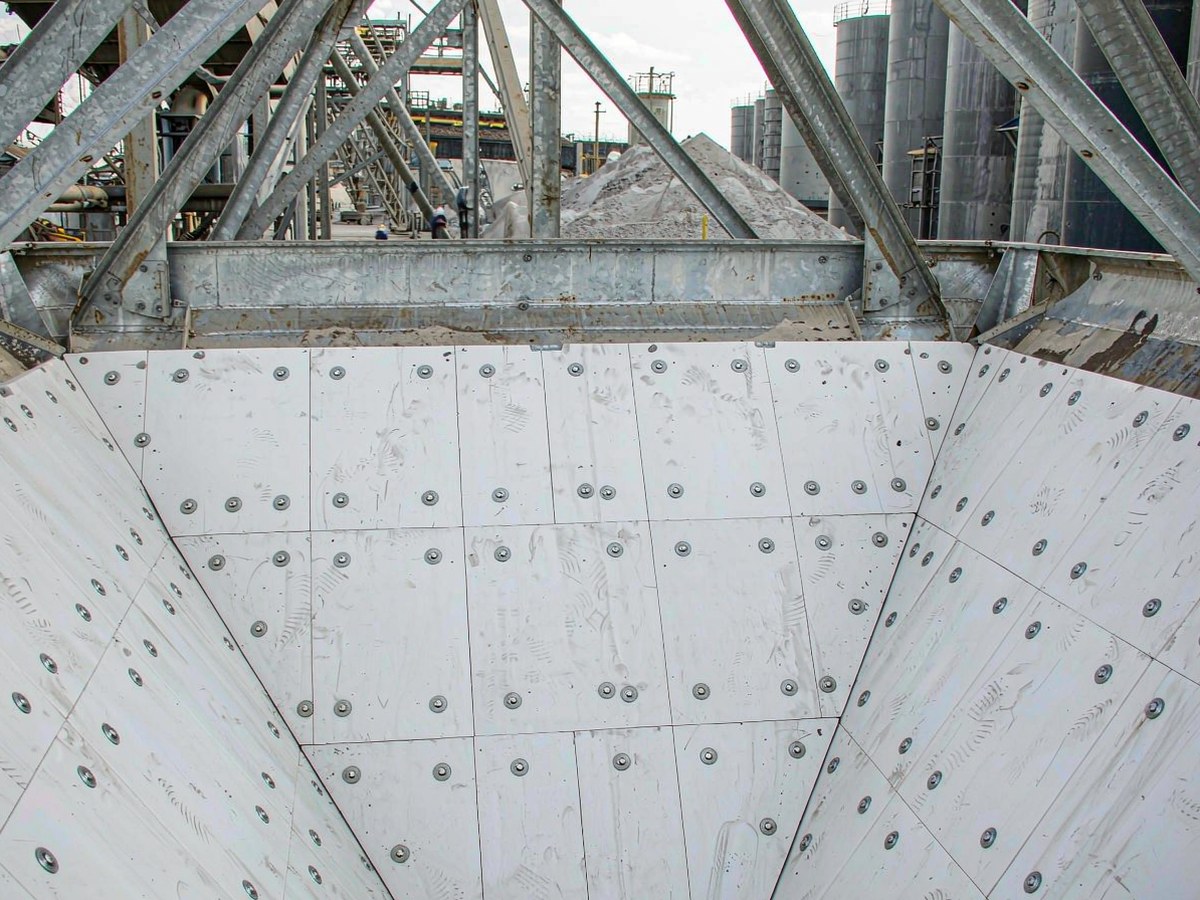
All three are lined with the same family of material, which is why buyers lump them together. The loads are not the same. A chute sees short, violent impact plus high-velocity sliding. A silo wall sees years of slow, low-angle sliding under a static column of product, and its failure mode is usually polishing and fine grooving rather than impact fracture. A hopper cone sits between the two and adds the worst problem of all: if the wall angle is too shallow for the product’s internal friction, the material arches or rat-holes, and no liner on the market will fix bad geometry.
That distinction drives thickness. Impact duty needs mass to absorb energy; sliding duty needs surface quality and enough thickness to survive years of gradual loss. Specifying 20 mm everywhere is not conservative, it is wasteful in the silo and often still marginal at the chute impact point directly under the feed.
UHMWPE has no single international grade designation. Suppliers use trade names and internal codes, and “PE-1000”, “PE-UHMW” and “UHMW-PE” all describe the same family without pinning down molecular weight, additive package or processing route. Two sheets sold under the same commercial label can differ by several million g/mol.
Ask for the molecular weight range in g/mol and the test method behind it, then ask for the abrasion loss figure from a recognised test such as the sand slurry method. Typical commercial ranges run from around 2 to 9 million g/mol. Higher molecular weight generally improves abrasion resistance and impact toughness, but it also makes the sheet harder to machine and weld, and it does not help at all if the sheet is too thin for the duty. For most bulk handling work, the middle of that range is the sensible economic point; the top of the range is justified for primary dump hoppers and transfer points handling sharp, coarse ore.
Recycled or reprocessed content is the other half of this field. Reprocessed UHMWPE can look identical and test noticeably worse, especially on impact. If the application is critical, state virgin resin in the purchase order and ask for a batch declaration. On a UHMWPE Liner Sheet for Silo, Chute & Hopper project where a single shutdown costs more than the lining, that clause pays for itself.
Thickness should be mapped onto the equipment, zone by zone, before the order is placed. The following bands reflect common practice in coal, cement, aggregate and mineral handling and should be treated as starting points for a wear calculation, not as a substitute for one.
For silo and bunker walls above the transition, where the product slides slowly at a shallow angle, 8 to 12 mm is usually sufficient, and going thicker mainly adds cost and weight. On hopper cones and sloped bottoms, 12 to 20 mm is the normal band, because the cone takes both sliding wear and the load of the product column during discharge. On transfer chutes, the straight run can use 15 to 20 mm, while the impact zone directly beneath the feed point commonly needs 25 mm or more, sometimes with a rubber backing layer to spread the impact load.
Where a plant handles a single abrasive product at one steady rate, one thickness may be acceptable throughout. Where the feed is intermittent and coarse, or where tramp metal is known to enter the stream, differential thickness with replaceable impact panels is cheaper over a five-year horizon than uniform heavy sheet.
Thickness tolerance is the most abused line in a liner quotation. A sheet quoted at 20 mm that measures 18.5 mm at the low points has given away nearly eight percent of its wear volume, and the buyer cannot see it on the invoice. Ask for the tolerance band in writing and for measurement points, typically five per sheet. Reasonable commercial tolerances for skived or pressed sheet are in the range of plus or minus two to five percent depending on thickness and process.
Dimensional tolerance matters just as much on cut-to-size panels. A panel that is 10 mm oversize will not fit between the stiffeners; one that is 10 mm undersize leaves a gap that fines will pack into and that will eventually lift the sheet. State the tolerance on length and width, and state squareness, because a parallelogram panel cannot be butted cleanly no matter how careful the installer is.
Flatness is the third item. Thin sheet that has been stored badly or cut from a coil will arrive with a set or a wave. That wave will not flatten under bolts, and it creates a void behind the liner where product migrates and abrasion accelerates. If the panels are large, specify flatness or specify that panels are cut from pressed sheet rather than from unrolled stock.
Colour is not decoration. In this industry it usually encodes the additive package, and buyers who order “any colour” often receive the cheapest one. Natural or white sheet is normally the unfilled, virgin grade and is the usual choice where food, feed or pharmaceutical contact is possible. Green is typically the general wear grade with pigment only. Black almost always indicates carbon black, added for UV stability in outdoor stockpiles and for some antistatic behaviour. Blue is frequently used for grades with improved machinability or for metal-detectable compounds.
Two functional variants deserve their own line on the data sheet. Antistatic and conductive grades matter wherever dust clouds form, such as grain and coal dust environments, and the specification should quote a surface resistivity target rather than the word “antistatic”. Flame retardant grades belong in enclosed transfer points and in underground or confined spaces, and should be quoted against a specific test standard. Neither variant can be verified by eye, so both need a certificate.
Temperature is the constraint that overrides colour and grade. Standard UHMWPE is normally rated for continuous service up to about 80 degrees Celsius, with short excursions higher. Hot clinker, calcined material and steam-cleaned chutes exceed that, and the sheet will soften, creep and pull through its fasteners. If the product stream runs hot, say so in the enquiry; the answer may be a different lining material rather than a thicker sheet.
The liner is only as good as its fastening. Two numbers decide whether the installation survives its first thermal cycle. The first is the coefficient of linear thermal expansion, which for UHMWPE is roughly 1.5 to 2 x 10^-4 per Kelvin, an order of magnitude higher than steel. The second is the temperature swing the equipment actually sees.
Put together, a three metre panel exposed to a 30 K swing will try to grow by roughly 15 to 18 mm. Fixed rigidly at both ends, it has nowhere to go, so it buckles into a wave or shears at the bolt holes. The specification must therefore require slotted or oversize holes in the direction of movement, a fixing pattern that anchors the panel at one reference edge, and cup washers or batten strips that spread the clamping load. Countersunk heads are preferred inside the flow path, but they must be seated in a machined recess, not forced into the sheet.
State the fastener material as well. Stainless fasteners in a coal or fertiliser environment cost more and last longer than zinc-plated ones; the difference is trivial against the labour cost of a re-lining. If the plant intends to wash down the equipment, say that too, because wet fines behind a loose liner are the fastest route to a torn sheet.
A liner delivery should include a batch or lot number traceable to the resin, a certificate of analysis covering molecular weight and density, and the measured thickness of each sheet against the tolerance you specified. Density for UHMWPE sits around 0.93 to 0.94 g/cm3, which is a useful sanity check: a sheet sold as UHMWPE that measures noticeably higher may be filled or may not be UHMWPE at all.
For cut-to-size work, ask for a dimensional report and, on complex panels, a first-article inspection. Where the panels are drilled to match existing steel, ask for a drilling template or a marked-up drawing returned with the delivery, so the next re-line does not start from a survey again.
A workable data sheet for lined silos, hoppers and chutes therefore carries six blocks: equipment and duty description, product handled with moisture and temperature, grade and molecular weight with additive package, thickness per zone with tolerances, panel dimensions and fixing details including expansion allowance, and documentation requirements. Add the installation method, because a good sheet installed with uniform over-torqued bolts will fail in the same way as a bad one.
Buyers who write those six blocks get comparable quotes and fewer surprises. Buyers who send one line get whatever the market happens to have on the floor that week, and they generally discover the difference at the first unplanned shutdown.
If you are specifying a UHMWPE Liner Sheet for Silo, Chute & Hopper installation and want a second opinion on grade and thickness, send us the equipment drawing, the product handled and the operating temperature. We will come back with a zone-by-zone recommendation and flag anywhere the geometry, rather than the material, is the real constraint. Related guides cover chute liner selection and fixing and U-shape liner profiles for troughs and transfer points, and the full UHMWPE liner sheet range lists available thicknesses and panel sizes.