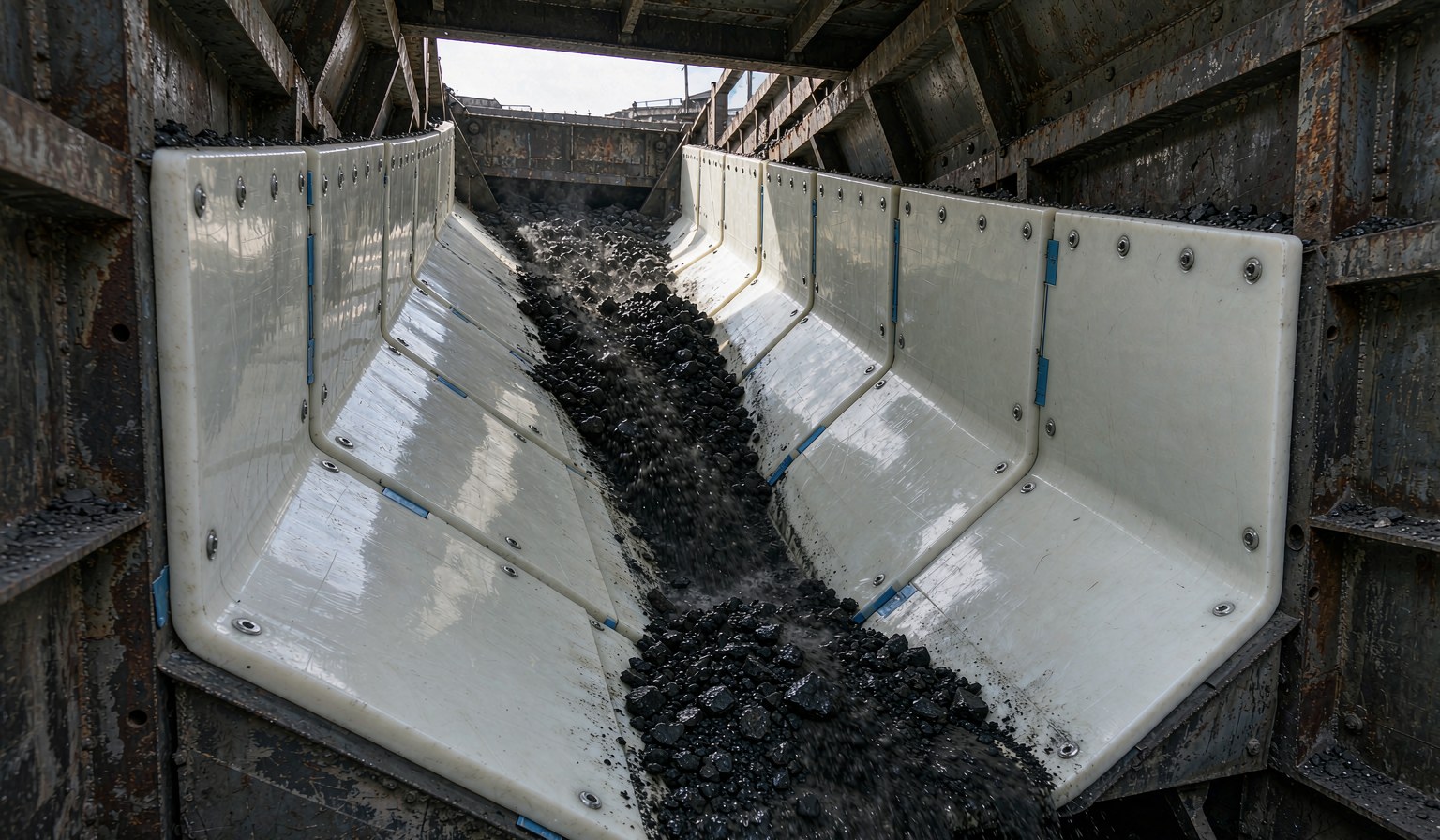
A chute liner that fails inside a year almost never fails because the material was bad. It fails because the sheet was too thin for the impact zone, because the grade was picked on price rather than on abrasion duty, or because the fixing method let the plate work loose and tear at the bolt holes. All three are specification errors, and all three are avoidable before the first sheet is cut.
This guide walks through how we specify UHMWPE chute liners for bulk handling: what determines thickness, what molecular weight actually changes, and which fixing detail causes most premature failures in the field.
Two chutes handling the same tonnage can need liners four times apart in thickness, because tonnage is the wrong number to design from. What matters is how the material arrives. A transfer chute where coal drops two metres onto a dead bed sees a completely different load case from a sloped chute where material slides continuously at three metres per second.
So before choosing a sheet, describe the chute in three numbers: drop height at the loading point, belt or feeder speed, and the largest lump size. A 300 mm lump of limestone at a two metre drop delivers a point impact that no sliding-wear calculation accounts for. That is the case where thin liners perforate in months while the wear charts still say the sheet has years of life left.
The most common specification mistake is running one thickness through the whole chute. A chute is not one wear environment. Split it into zones and size each one.
The impact zone, directly under the loading point, takes the concentrated energy of falling material. Here thickness is doing structural work as much as wear work: it needs enough section to absorb impact without cracking or cold-flowing around the fasteners. Operators running high-drop transfer points typically need significantly heavier sheet than the sliding section downstream.
The sliding zone carries the steady abrasion. Wear here is proportional to sliding distance and to the abrasiveness of the material, so a long decline section can wear as fast as a short impact zone even at lower stress. This is the zone where molecular weight grade pays off most.
The discharge and transition zones are where geometry forces the material to change direction. These corners see a combination of impact and sliding, plus the highest risk of build-up if the surface is not smooth. Keep the liner continuous through the transition; a joint at a corner is where material catches and where the sheet edges get pried up.
UHMWPE is defined by a molecular weight above roughly 3.5 million g/mol, but commercial sheet runs from about 3.5 to over 9 million. The reason grade matters is that abrasion resistance improves with molecular weight, but with clearly diminishing returns at the top end, while the practical costs keep climbing.
Higher molecular weight buys better wear resistance and better resistance to stress cracking. It also makes the sheet harder to machine, more prone to dimensional movement under load, and more expensive. For a sliding chute in coal or limestone, a mid-range grade usually gives the best cost per tonne handled. For a high-impact zone with sharp, heavy lump material, moving up in grade is justified because the failure mode changes from wear to fracture.
Two properties matter as much as the molecular weight number. The first is moisture absorption, which for UHMWPE stays below 0.01 percent and is why the material does not swell or soften in wet chutes. The second is the low friction coefficient, typically in the 0.1 to 0.2 range against steel, which is the reason sticky or damp material keeps moving instead of building up on the wall.
This is where most liner failures originate, and it has nothing to do with wear. UHMWPE expands roughly 0.15 to 0.2 mm per metre for every degree Celsius of temperature change, which is several times that of steel. A six metre liner installed tight in cold weather and then warmed by hot material will try to grow by several millimetres. If both ends are bolted hard, that movement has nowhere to go, and the sheet buckles or shears its fasteners.
Countersunk bolts through the sheet work well when the liner is short and the temperature stable, provided the holes are slotted slightly to allow movement rather than clamping the sheet rigidly. T-track and dovetail systems are more tolerant because the sheet can slide along the track. Bonded installation suits thin liners on smooth substrates, but the adhesive becomes the wear part if the bond line is not continuous.
Whichever method is used, leave expansion allowance at every free edge and never butt two sheets tight together. A few millimetres of gap at the joint is cheaper than a buckled liner. Also recess or protect bolt heads: a bolt head standing proud of the liner surface becomes the first thing the material grinds away, and once the head is gone the plate is loose.
Cold flow at the fasteners is the classic one. UHMWPE creeps under sustained load, so a bolt tightened hard into a thick sheet slowly loses preload and the plate begins to move. Wider washers and larger bearing area under the head slow this down considerably.
Edge lifting comes from constrained expansion or from material catching on a proud edge. Once an edge lifts, material gets behind the liner and the problem accelerates. Chamfer the leading edges and keep them below the flow line.
Embedded particle wear is less obvious. Fine abrasive dust works into the gap between liner and substrate and then acts as a grinding paste against the back face. Sealing the edges, not just bolting the face, prevents it.
Against carbon steel, UHMWPE chute liners last several times longer in sliding abrasion, weigh a fraction as much, and do not corrode in wet or acidic service. Against rubber, they handle sharp material better because rubber tears where UHMWPE slides, and they resist build-up of damp fines far better. Against ceramic tiles, they are easier to fit and far more tolerant of impact, though ceramic wins on pure high-temperature abrasion.
The limits are real. Continuous service temperature above roughly 80 degrees Celsius is outside the comfortable range. Heavy point impact from very large lumps can exceed what any polymer sheet handles, and that is a case for a steel impact plate or a dead-box design. And UHMWPE is not a structural material: it needs a substrate to carry the load.
It depends on drop height and lump size far more than on tonnage. A low-drop transfer with sized coal can run much thinner sheet than a high-drop loading point handling run-of-mine material. Specify the impact zone and the sliding zone separately rather than applying one thickness throughout.
Continuous service is comfortable up to about 80 degrees Celsius. Above that, both the mechanical properties and the expansion allowance need rethinking, and a different material may be the better answer.
Standard woodworking tools work: circular saw or jigsaw for cutting, conventional bits for drilling. Keep the sheet supported and use sharp tooling, because UHMWPE melts rather than chips if the tool rubs. Slot fastener holes slightly to allow for thermal movement.
They reduce it substantially, which is why they are common in damp or sticky duty. The low friction coefficient means material slides instead of adhering. Keeping joints flush and edges chamfered matters as much as the material itself.
If you are specifying liners for a new chute or replacing a set that failed early, send us the chute drawing with drop height, material type and lump size, and we will recommend thickness and grade zone by zone. Our UHMWPE sheet range covers thicknesses from thin wear plate through to heavy impact sections, and we machine fixings to your pattern.