A polymer idler is not an upgrade, it is a substitution, and it only pays off when the failure you are fighting is corrosion, carryback or belt damage rather than raw load. Get that wrong and the roller that runs eight years on a wet coal yard collapses in a season under a chute dropping 300 mm limestone.
What follows is what a purchase order for UHMWPE conveyor idler rollers has to lock down: shell wall, resin grade, colour, diameter, bearing and seal, and the running tolerances that decide whether the roller lasts or shakes itself apart.
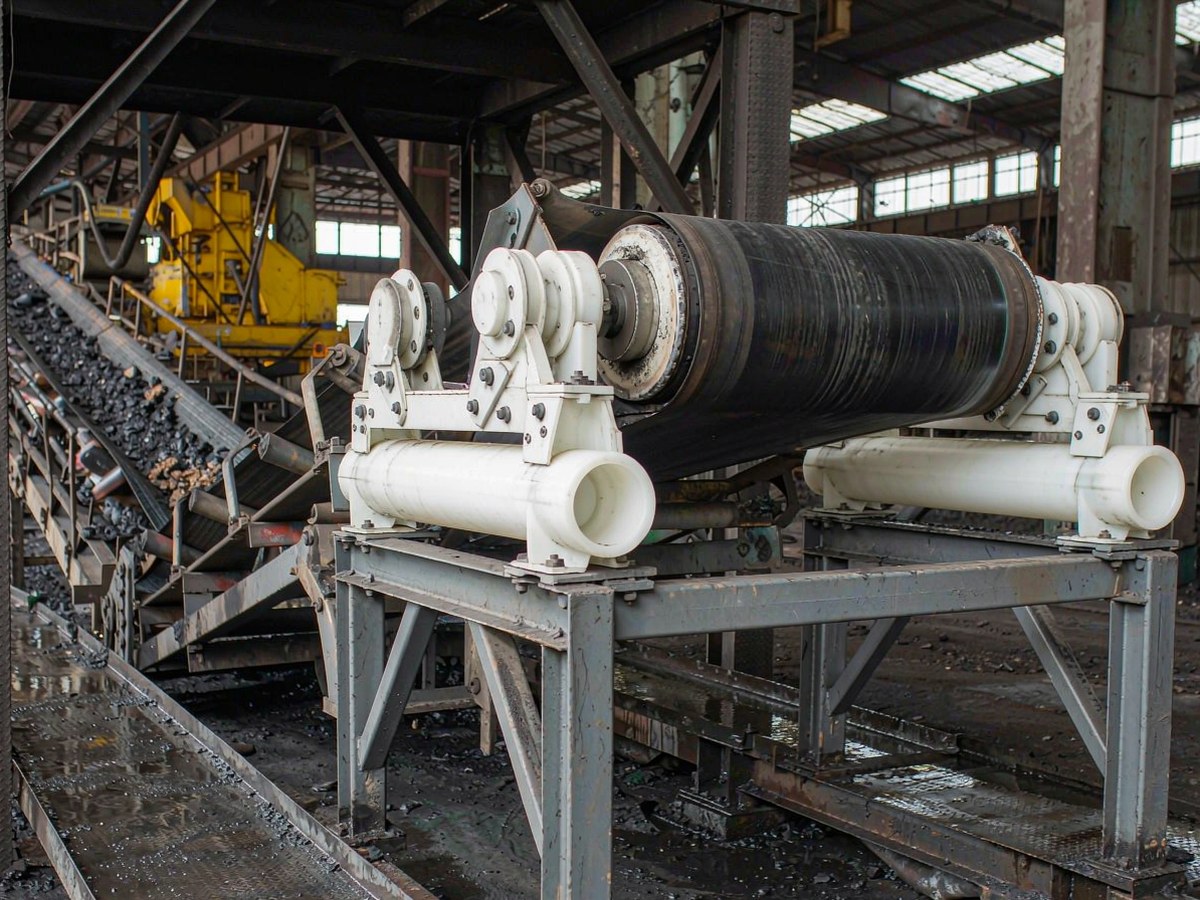
On a steel idler in wet duty the sequence is predictable. Paint fails, the tube rusts, rust and moisture give sticky fines somewhere to anchor, and carryback builds a sleeve around the shell. That sleeve changes the effective diameter, the belt drifts, the skirt rubber is adjusted to chase the drift, and eventually a bearing seizes. A seized steel shell turning in a stalled belt is a grinding wheel and will cut through a carcass in minutes.
A polymer shell breaks that chain at the first step. It cannot rust, and its low surface energy means wet coal, gypsum and fertiliser do not build a sleeve on it. The failure mode is also benign: a worn shell goes smooth and round instead of developing a sharp edge, so even a badly worn roller rarely destroys the belt. That is worth more than the purchase price on lines where one splice costs more than a station of idlers.
UHMWPE conveyor idler rollers do not fix load class, impact or frame geometry.
Steel shells run 4 to 6 mm of wall. Polymer shells run thicker, 6 to 10 mm here, and the instinct is to read the extra millimetres as strength. It is mostly not. Most of that wall is sacrificial material you have bought the right to wear away before the roller comes out.
Some of it is stiffness. For a thin-walled tube the second moment of area scales roughly with radius cubed times wall, so deflection varies inversely with wall thickness. Going from 6 mm to 10 mm cuts sag by around 40 percent at the same diameter and load. Sag flattens the trough angle, the belt lifts off the adjacent rollers and spillage starts at the edges, so on a 1200 mm face carrying heavy load, 6 mm is the wrong choice even though it is cheaper and the catalogue lists it.
Match wall to span and load rather than price. Short faces on light duty live with 6 mm. Long faces, high belt tension, or any position directly under a load point should go to 8 or 10 mm. Ask for the deflection figure at your rated load rather than the wall thickness alone, and if the supplier cannot produce it, that is your answer.
Polymer shells do not wear evenly. The centre of the face carries the most load and wears fastest, so the shell takes on an hourglass profile. That is where maintenance programmes go wrong: the wear is invisible from the walkway and the roller still turns freely.
Once the centre diameter drops, its surface speed falls below belt speed. A shell 4 mm under nominal at mid-face runs a measurable percentage slower than the belt above it, and the difference is taken up by sliding. Sliding is far more aggressive than rolling contact, so the wear rate climbs. A roller can take years to lose the first 2 mm and only weeks to go from 3 mm to worn through. Wear here is not linear, and any interval built on a linear assumption will miss the failure.
Measure with a pi tape at three points, both ends and the centre, on a fixed sample per zone. You are looking for diameter spread along the face, not the absolute number. Retire the shell when radial wear reaches roughly 30 to 35 percent of original wall, about 3 to 3.5 mm of diameter loss on a 10 mm shell.
Replace carry-side rollers in sections, not one at a time. A single new roller standing 3 mm proud of worn neighbours sits higher, takes a disproportionate share of the load and wears faster from installation. Individual change-out is defensible only on low-tension return positions.
UHMWPE is a family, not a specification. Molecular weight runs from roughly 3 to 9 million g/mol and every mill has its own labels. PE300, PE500 and PE1000 are trade designations, not standards, and they are not comparable across suppliers. Writing PE500 on an order tells the mill almost nothing.
Specify measurable properties instead: intrinsic viscosity to ISO 1628-3 or ASTM D4020, density in the 0.93 to 0.94 g/cm3 band, ash content, and whether the resin is virgin or reprocessed. Intrinsic viscosity is the honest proxy for molecular weight and the one number a mill cannot fudge without failing its own certificate.
Reprocessed material is common in roller shells for a defensible reason, because a thick shell is a forgiving section and regrind is cheap. The risk is ash and foreign particle content: hard inclusions become stress risers at the bore, exactly where section is thinnest and stress highest, and they surface later as radial cracks. If the line matters, specify virgin resin and require the ash figure.
Black is the default because carbon black is the cheapest effective UV stabiliser. An unpainted natural shell in an open stockyard will chalk, craze and crack within a few years of direct sun, so outdoors black is a requirement, not a preference. Ask for carbon black content by percentage, not for the word black on the drawing.
Antistatic and flame-retardant grades both carry fillers, and fillers dilute the polymer, so expect measurably lower impact strength and abrasion resistance. Do not specify FRAS everywhere for uniformity and then wonder why life dropped. Specify it only where area classification or fire strategy requires it, with the resistivity band and test method on the order.
Do not copy the dimensions off the roller you are removing. A worn roller has been measuring the wrong thing for years, and copying it propagates whatever error put it there.
Work from the frame instead. Face length should be belt width plus 50 to 100 mm, enough that the belt cannot walk off the shell edge during a transient. Shaft diameter and bearing size follow the CEMA load class and slot spacing, not the old part number. Diameter follows belt width and spacing: at the same load a smaller diameter runs at higher rpm and shortens bearing life, so a small-diameter polymer roller is often a false economy on a fast line.
Almost every idler that comes off a conveyor failed at the bearing. The shell is usually still serviceable, which is worth remembering when comparing suppliers on shell material.
Field evidence supports that. An audit published in 2026 of a South African overland coal conveyor found 96 percent of three-roll return idlers still running ten years and ten months after commissioning, six failures in 153 rollers, after 150 million tonnes. Those were steel shells with HDPE lining on 4.5 m carry and 9.0 m return spacing, and the surviving population was governed by sealing and bearing selection rather than shell wear.
Choose the seal by environment, not price. A single labyrinth is adequate in a dry sheltered gallery. For wash-down, salt spray or dust that wets and dries repeatedly, specify triple labyrinth: those conditions fail at the end cap, and nothing else in the roller matters once water is inside. Felt seals suit dry abrasive duty and nothing wet.
Bearings run from 6204 to 6310 in this range, from HRB, LYC, SKF or NSK. Sealed for life is the correct default. Relubrication points on small idlers mostly admit contamination rather than extend life, so if a supplier offers a grease nipple as a feature, ask what it is for.
For UHMWPE conveyor idler rollers as assembled, radial runout should land between 0.40 and 0.50 mm, axial runout under 0.70 mm, rotation resistance between 1.50 and 2.50 N, and axial load capacity between 8.0 and 10.0 kN. After a drop test the limits relax to 0.70 mm radial, 1.50 mm axial and 3.75 N, with axial capacity still at 10.0 kN.
Runout matters more than it looks. Total indicated runout becomes an impulse once per revolution, and on a 127 mm shell at 3 m/s that is roughly seven impulses per second per roller, multiplied by every roller under the belt. That vibration works the seal lip and pumps dust past it. A batch with 1.2 mm runout will not fail at goods-in, it will fail two years early in service.
Rotation resistance is the check any fitter can run with a spring scale and a length of cord, and it catches damaged seals and over-greased bearings before they reach the frame. Anything above about 3.75 N on a new roller should be rejected at the gate. The drop test exists because shells crack at the bore when dropped in handling, and a dropped roller is no longer the roller you paid for.
UHMWPE shells are good from about minus 30 to plus 80 degrees C continuous. Above 80 the material creeps under load, the shell loses roundness and runout grows until the belt feels it. That rules out hot clinker, kiln dust, asphalt and any transfer where material arrives hot. It is a hard limit, and no wall thickness buys margin against it.
Chemically the shell is comfortable with most acids, alkalis, salt solutions and slurries, which is the point of specifying it for fertiliser, potash, salt and pickling lines. It is not suitable for strong oxidising agents, aromatic solvents or chlorinated hydrocarbons. If the belt carries a process chemical rather than a mineral, check the specific medium instead of assuming polymer means inert.
Where a polymer idler is simply wrong: directly under a chute dropping large lump material, where repeated deformation at one spot cracks the shell at the bore; above 80 degrees C continuous; and on very long spans where sag is already tight, because a polymer shell deflects more than steel at the same diameter and the trough depth you lose becomes spillage. Under a chute use an impact roll with rubber discs and tighter spacing; on long spans go up a diameter rather than thicken the wall.
Hourglass wear at mid-face means the wall or spacing is too light for the load at that position. A shell worn through to a thin ring means nobody measured it. Bearing seized with a flat-spotted shell means water got past the end cap, so the seal is wrong for the wash-down regime. A radial crack running out from the bore means impact damage or an interference fit too tight on installation. An ovalised shell means temperature exceeded the creep limit.
The order should carry: shell diameter and face length with the belt width they are sized against; wall thickness and deflection at rated load; resin grade as intrinsic viscosity with test method, plus density and ash; virgin or reprocessed, stated explicitly; colour and carbon black percentage if outdoors; antistatic or FR only where area classification demands it; bearing number and brand tier; seal type; shaft diameter and shaft end drawing; runout at assembly; and rotation resistance limit.
If you are replacing liners in the same shutdown, order the wear resistant UHMWPE sheet for the chute and UHMWPE bar for machined spacers on one drawing set, so chute, skirt and idler frame are dimensioned together rather than guessed on site.
The UHMWPE conveyor idler rollers in this range cover 89 to 219 mm diameter, 6 to 10 mm shells and faces to 3500 mm, machined to drawing for shaft ends, bearing combinations and shell colour. Send the frame drawing, belt width, material carried and wash-down regime, and we will come back with a wall thickness and a seal specification rather than a catalogue page.