A ground protection mat is not a magic carpet that makes soft ground hard. It is a load spreader, and it only works when the load path from tyre or track to subgrade is understood before the specification is written. Most mat failures we are asked to diagnose are not material failures at all. They are specification failures: a mat chosen by headline “tonnage” that had nothing to do with the actual contact pressure, or a joint detail that opened up on the second pass of a loaded truck.
This guide is written for the engineer or buyer who has to write the purchase order, not for the brochure. It covers what the mat actually does, how to read load claims, how thickness is selected against subgrade and traffic, where UHMWPE and HDPE genuinely differ, and which line items belong in the specification so the delivered product matches the quote.
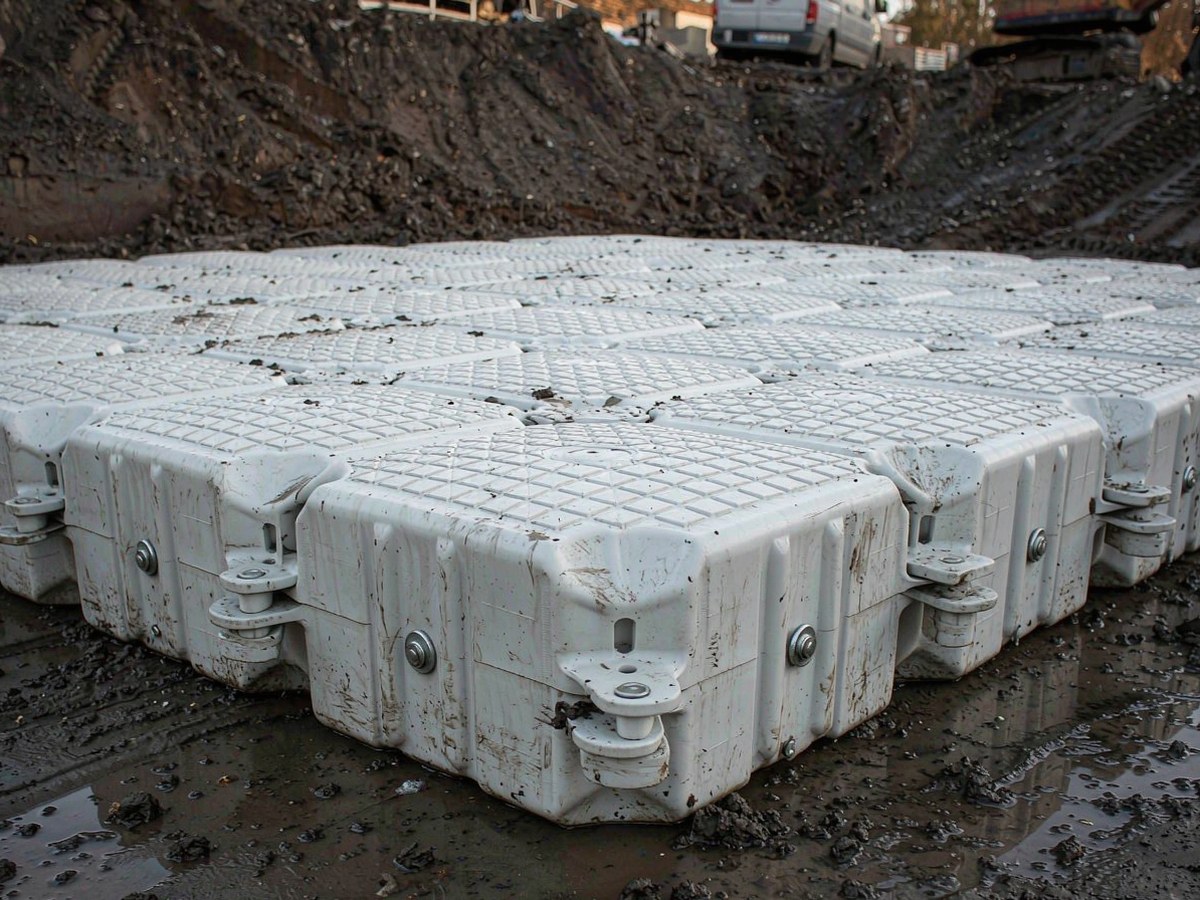
Ground protection mats work by two separate mechanisms, and confusing them is the root of most bad specifications. The first is load spreading: a concentrated contact patch is distributed over a larger area of ground. The second is surface protection: the subgrade is kept from rutting, mixing and contamination, so the running surface stays clean and repeatable.
Neither mechanism increases the bearing capacity of the soil underneath. If the subgrade cannot carry the distributed pressure, the mat settles with it and the vehicle still bogs down. This is why a supplier who quotes a single load figure in tonnes without asking about ground conditions is telling you nothing useful.
The controlling number is ground bearing pressure in kPa, compared against the actual site soil. Firm compacted granular fill, wet clay and peat are three different design cases, and no specification can be correct until the case is known.
Tyre and track pressures differ by an order of magnitude, and this single fact invalidates most catalogue “load capacity” figures. A tracked excavator spreads its mass along the full track length, while a wheeled truck concentrates it into four or more small contact patches.
Take a 20 tonne tracked excavator with 3.2 m by 0.6 m tracks on each side. The total contact area is about 3.84 square metres, so the average ground pressure is roughly 52 kPa. Now take a 40 tonne tipper with a rear axle load near 26 tonnes on eight rear tyres. Each tyre carries about 3.25 tonnes over a contact patch of roughly 0.06 square metres, which gives around 540 kPa. The same “forty tonne” class of machine, and a tenfold difference in what reaches the ground.
So the first question to ask is never “how much does the vehicle weigh”. It is “what is the contact pressure of the heaviest single wheel or track, and how long does it stay in one place”. A stationary crane outrigger is a sustained point load and will creep into the subgrade over hours, while a moving truck applies a short impulse. Sustained loads need more bearing area or a stiffer load spreading layer, not a thicker mat alone.
Thickness does two jobs. It provides stiffness so the mat bridges soft spots rather than following them down, and it provides edge strength so the mat survives being driven on and off at the joints. On a soft subgrade the mat behaves like a plate on an elastic foundation, and the bending moment rises quickly as the support weakens. That is why thickness requirements escalate on poor ground rather than scaling smoothly with vehicle weight.
As a practical starting point for UHMWPE ground protection mats: 12 to 15 mm suits pedestrian access, wheelbarrows, light site vehicles and turf or finished-surface protection. 18 to 25 mm covers pickups, telehandlers and mini plant up to about 7 tonnes on firm ground. 25 to 38 mm is the working range for loaded tippers and concrete trucks on compacted fill. Above 38 mm, with larger panel sizes and a properly prepared base, is where heavy crane and rigging traffic belongs.
Panel size matters as much as thickness. A larger panel spans more soft spots and needs fewer joints, but it is heavier to handle and expands more with temperature. A 2.4 by 1.2 m panel at 25 mm is already around 70 kg in UHMWPE, a two-person lift with handles.
Do not expect the mat to solve a genuinely weak base. The classic 45 degree load spread through a 25 mm mat enlarges a 300 by 200 mm contact patch to roughly 350 by 250 mm, cutting pressure by less than a third. That is a useful improvement on marginal ground and a rounding error on a bog. Prepare the base, then specify the mat.
Both materials are polyethylene, and both are sold as ground protection, but they are not interchangeable in cold weather or under impact. UHMWPE sits in the 3.5 to 9 million g/mol range for molecular weight, while conventional HDPE is far lower. The practical consequence is a much longer molecular chain, which translates into dramatically better impact strength, notch resistance and abrasion resistance.
On site this shows up in two places. In winter, HDPE panels become notch sensitive and a struck edge can crack clean through, while UHMWPE absorbs the same hit. Under repeated heavy traffic, HDPE develops surface cracking and spalling at the running surface sooner. If the mats will be used below about minus 10 Celsius, or will be lifted and dropped repeatedly by machine, the higher grade is not an upsell, it is the requirement.
The trade-offs are real and worth stating. UHMWPE costs more per kilogram, is harder to weld or field repair, and has a higher coefficient of thermal expansion, so joint and fixing details need more attention. For a permanent yard pad in a mild climate with light traffic, HDPE is a rational choice. For a rental fleet that travels between sites in all seasons, UHMWPE pays for itself in survival rate.
Ask the supplier for the grade evidence, not the trade name. Intrinsic viscosity or a molecular weight range against a recognised test method, plus a statement of virgin versus recycled content, is what actually distinguishes one quote from another. Recycled content is not automatically bad, but it must be declared, because it changes impact behaviour at low temperature.
UHMWPE has a low coefficient of friction, which is exactly what you want in a chute liner and exactly what you do not want under a wheel. The material’s self-lubricating character has to be compensated by the surface pattern, and the pattern has to be specified, not left to the factory default.
Raised stud patterns give the best grip on wet grass, mud and snow, and they are the right choice for turf protection and temporary walkways. Diamond or chevron rib patterns clear water better and resist clogging with clay, which makes them the better choice for vehicle routes. A deep pattern on soft ground is self-defeating: the studs press into the subgrade and the mat stops spreading load, because the effective contact area has collapsed to the tops of the studs.
Cleaning access matters more than most buyers expect. Mud packed into a pattern turns a gripping surface into a smooth one within a few passes, so specify a pattern depth and an open area that can be cleaned with a pressure washer on site.
Most field failures happen at the joint, not in the middle of the panel. A joint that steps or opens under load creates an impact edge, and impact edges chip, which then propagates into the panel. The joint detail deserves more specification attention than the material grade.
Interlocking lug and socket systems are fast to lay and good for pedestrian and light vehicle use, but they rely on the subgrade staying flat under both panels. Through-pin or bolted connections resist separation better on uneven ground and on curves, at the cost of laying speed. Where vehicles turn repeatedly on the mats, specify a pinned joint and expect to inspect it.
Two rules prevent most joint problems. First, run joints across the direction of travel where possible, so a wheel crosses a joint rather than running along it. Second, compact the strip under each joint as carefully as the rest of the base; the joint is where any settlement shows up first, and a void under a joint will open it within a shift.
Black is the default for a reason. Carbon black is an effective and cheap UV stabiliser, so a black mat in full sun holds its mechanical properties for years. Light colours reduce surface temperature and improve visibility, but need a proper UV stabiliser package to match that service life, and it should be confirmed in writing.
Thermal movement is the detail that catches out first-time buyers. UHMWPE has a coefficient of linear expansion in the region of 1.5 to 2.0 times ten to the minus four per Kelvin. On a 2.4 m panel, a 40 Kelvin swing between a cold night and a hot afternoon produces roughly 14 to 19 mm of movement. That movement does not disappear; it either opens the joints or buckles the surface.
The design response is simple and routinely skipped: leave a gap at every fixed edge, use slotted or oversize holes for any through fixing, and never trap a panel between two rigid restraints. Where mats butt against a kerb or a steel plate, that gap is the allowance that keeps the layout flat through the season.
Edge chipping is the most common complaint and almost always a handling or joint issue rather than a material one. Lifting with a fork through the panel edge, dragging panels across gravel, or driving a steer tyre against an exposed joint all initiate chips. Specify lifting points and train the crew, or budget for edge damage as a consumable.
Rutting beneath the mat is a subgrade problem presenting as a mat problem: shallow depressions tracking the wheel paths with an intact panel mean the base was not adequate for the contact pressure, and no thicker mat fixes it permanently. Thermal buckling, joint separation and surface polishing from prolonged traffic complete the list. A mat with thousands of passes behind it has its pattern worn smooth, so grip falls off long before the panel is worn through, which makes it a safety replacement trigger rather than a wear-life one.
Write the specification so two suppliers cannot quote against different products and still look comparable. At minimum it should state the polymer type and molecular weight range with the test method, the density, the panel dimensions with thickness tolerance, the surface pattern and depth, the joint type, the colour with UV stabiliser confirmation, and a declaration of recycled content.
Add the two items buyers most often forget: third party verification of load behaviour on a defined subgrade, and a certificate of analysis with batch traceability, which is what lets you reject a non-conforming delivery instead of arguing about it after the mats are on site.
For inspection on arrival, check thickness at five points per panel rather than one, measure flatness on a known flat floor, and look at the panel edges under good light for voids or delamination. Those three checks catch most of the quality spread between a genuine manufacturer and a repacker.
If the application is temporary roads for heavy plant rather than surface protection, the selection logic shifts toward larger panels, higher thickness and a pinned joint; our heavy duty paving slabs are built around that duty. For general fabrication, cutting and machined wear parts in the same material family, the UHMWPE sheet range covers the standard thicknesses. The full ground protection mats range lists panel sizes, patterns and connector options.
Send us the vehicle type, the heaviest single wheel or track load, the subgrade description and the layout length, and we will come back with a thickness and joint recommendation rather than a price list. That conversation usually saves more money than a discount on the panel rate.